
By Susanna Michael, Postdoctoral Scientist, Bigelow Laboratory for Ocean Sciences
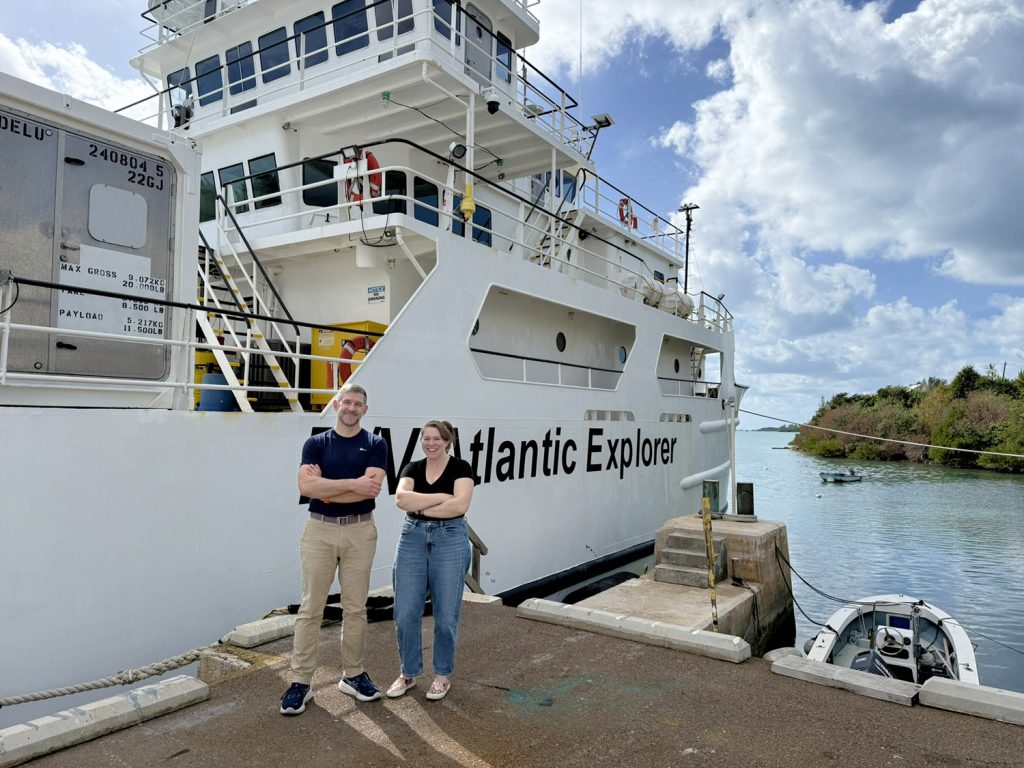
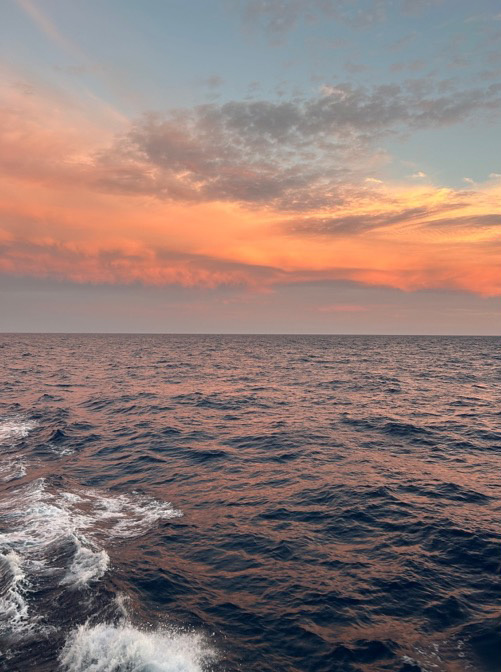
This March, I swapped Maine mud season for Bermuda spring — with plenty of sun and 70-degree temps — and set sail on the R/V Atlantic Explorer for a week of trace metal sampling.
As a postdoc with Senior Research Scientist Ben Twining, I’m part of a team studying the role of dissolved organic carbon in the formation of what’s called authigenic iron. This work builds on previous studies that researchers in our group participated in to determine the importance of the “colloidal shunt,” a proposed mechanism for moving iron from the surface to the deep ocean.
Iron is an essential nutrient for phytoplankton — it’s critical for photosynthesis, among other things — and while it is abundant in the Earth’s crust (and on a rusty ship!), it’s found in very small quantities in the ocean.
It also has a complicated chemistry.
In order for phytoplankton to use iron from the water, it must be either truly dissolved or bound to small organic molecules called ligands. Think about making pour-over coffee: the coffee that passes through the filter is your dissolved fraction; the grounds left behind are the particles.
Historically, we have considered particulate iron in two pools. One pool is “land derived,” or lithogenic, which is chemically resistant to breakdown or use by phytoplankton. The other pool is called “labile,” and we think of it as largely comprised of biological particles.
Lately, though, we’ve been focused on a third pool of particulate iron. Authigenic iron is also labile, but formed in the water column through chemical precipitation and the aggregation of tiny iron particles called colloids. We think that the formation of these particles may be facilitated by dissolved organic carbon in the seawater. Because iron is so important for phytoplankton growth, understanding this different form of iron and its role in the iron cycle is essential for creating models that better predict primary production.
This is cruise number two in a series of five to try to capture the seasonal cycle of carbon and iron cycling. My experience of the first cruise in November is a bit of a seasick blur, so I was a little anxious going into the second cruise. But, by the time March rolled around, we had ironed out some kinks (pun intended), and the weather looked amazing. When we arrived at the Bermuda Institute of Ocean Science, all signs pointed to a successful expedition.
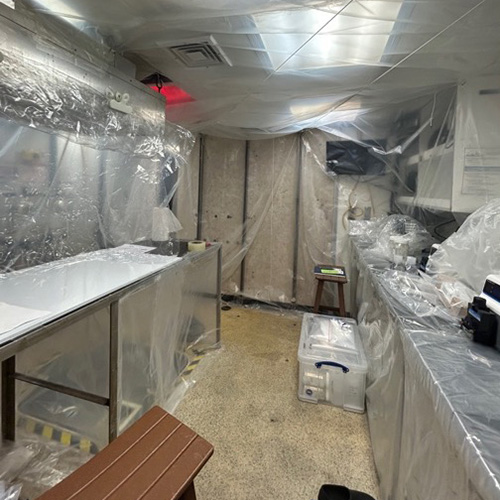
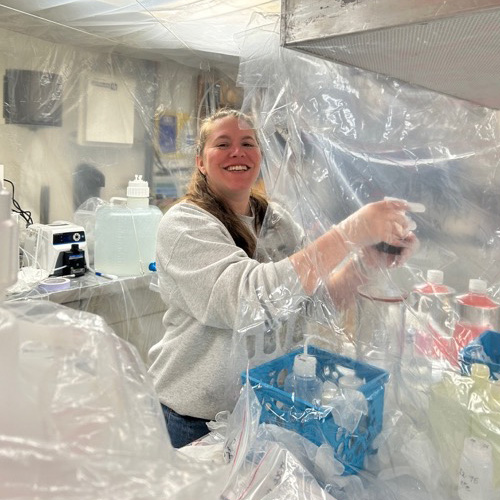
Before we could leave port, we first had to build a trace metal bubble in the lab. Because ships are rusty and we want to measure very small concentrations of iron in the water, we have a number of protocols to minimize contamination, including putting in HEPA filters and plastic sheeting in the lab.
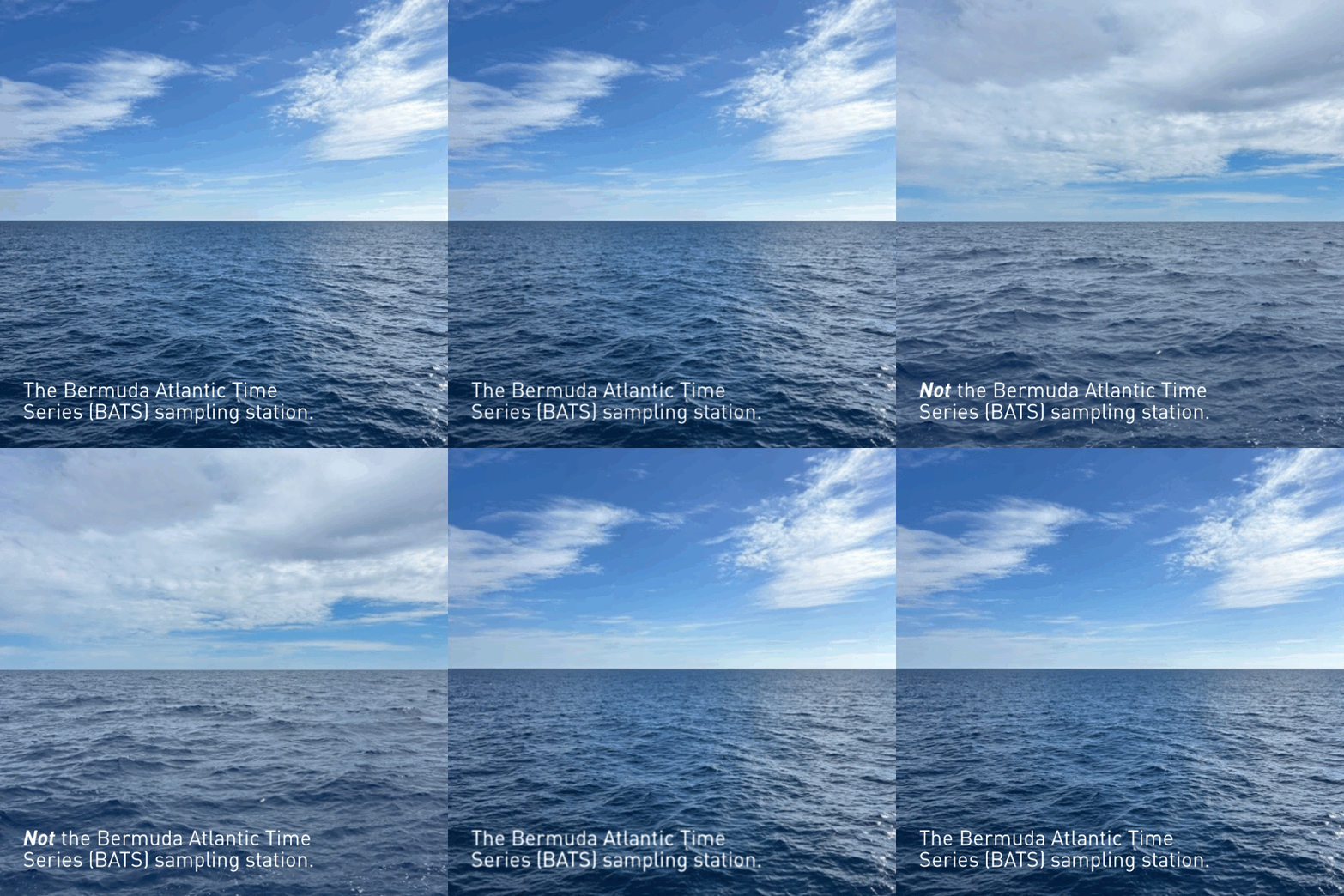
Once we set sail, the first station we stopped at was part of the Bermuda Atlantic Time Series (BATS). This spot has been sampled roughly every month since 1988, providing an invaluable time series of physical and chemical measurements from the North Atlantic (from the surface, it looks like every other station, but, as a big fan of time series, it was cool to work there, and watching the BATS team do their thing was a highlight of the trip).
The sampling day kicks off early and with the expected chaos. We start with the TowFish, a weighted, torpedo-like piece of equipment that pumps clean seawater from the surface directly into our trace metal bubble. We fill bottles with this filtered water to measure dissolved organic carbon, ligands, and dissolved metals, and I preserve a filter that has trapped particulates on it that I can measure back home.
We then send the trace metal CTD rosette down, which carries our Niskin bottles, another piece of equipment that is specially designed to avoid contaminating our samples. As it sinks, we track different physical parameters — like temperature, salinity, and oxygen — and make decisions about where to sample. We’re interested in a few specific spots, including the surface ocean and deep chlorophyll maximum, where phytoplankton growth is highest.
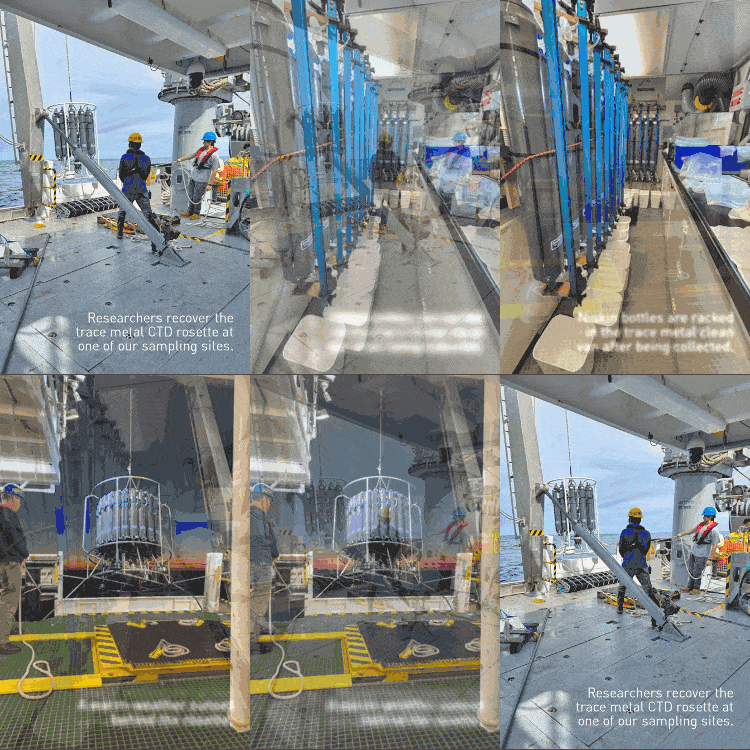
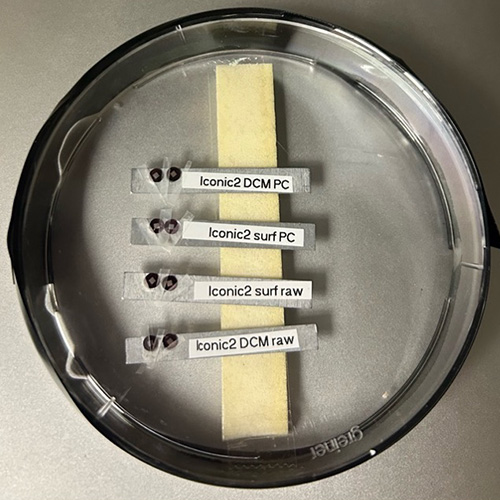
When the rosette comes back on board, the Niskin bottles get moved into the trace metal clean van. I quickly grab a Nalgene-full of water from the shallowest sample to prep for analysis later at the synchrotron, a specialized particle accelerator where we measure how many iron atoms are in a plankton cell relative to the atoms of carbon. That will tell us how much iron phytoplankton are actually using.
My colleagues sample the bottles for all the dissolved measurements, and I come in after to sample for particles. It’s the same idea as what we did with the surface samples but with a slightly different protocol (we’re basically tapping the Niskin bottles like maple trees and pushing the water through a filter) and a whole lot more samples.
We do that whole process twice more over the course of the week. Each day is long, but it gets easier the more we do it. We also shipped out at just the right moment: the ocean is transitioning from winter, where the water is really well-mixed, to spring, where stratification sets in and phytoplankton bloom — and we’re there to capture it!
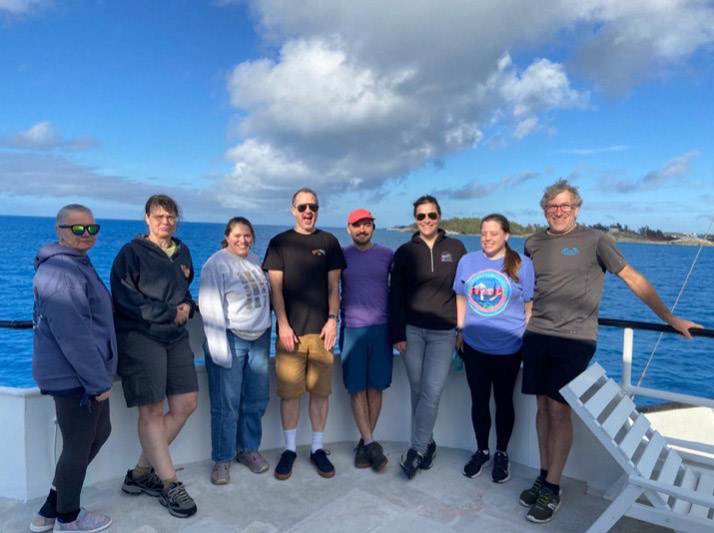
Lots of the seemingly mundane things that happen in between fieldwork also feel really special. I spent a lot of time just staring at the horizon. We saw whales. We ate plenty of watermelon and the most delicious coconut tapioca. It was a week of beautiful sunsets and good company — all which doing some really cool science.
Back home, I got to briefly enjoy Maine’s false spring before the lab headed to the Advanced Photon Source outside of Chicago to quantify the trace metal content of the cells.
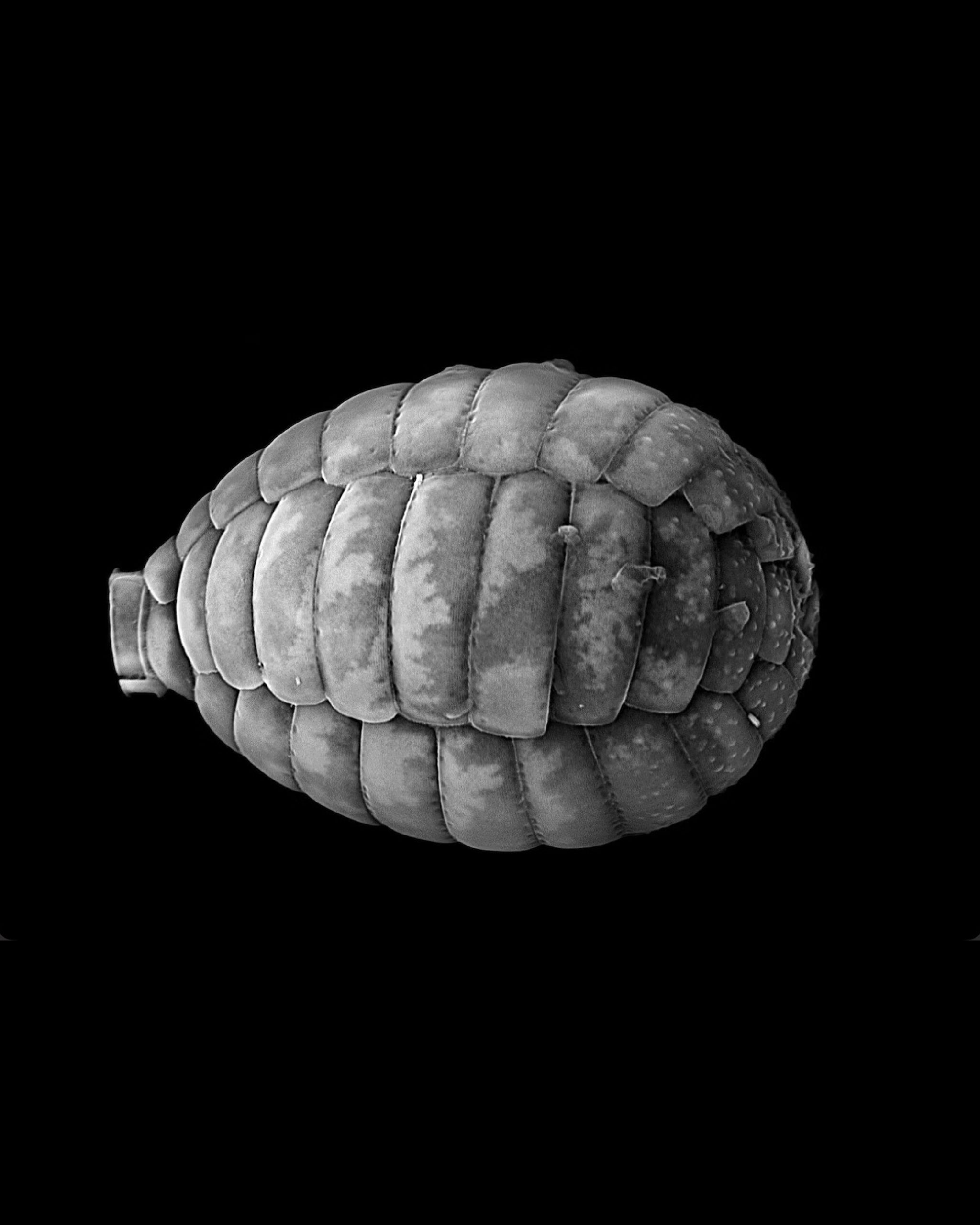
The phytoplankton are small (many are shaped like tiny avocados if you can imagine), but hopefully they will help us understand the cycling of biologically-derived iron, so that we can begin to understand this authigenic pool better. The work is scientifically important but the experience is made more special knowing exactly where these samples came from.