

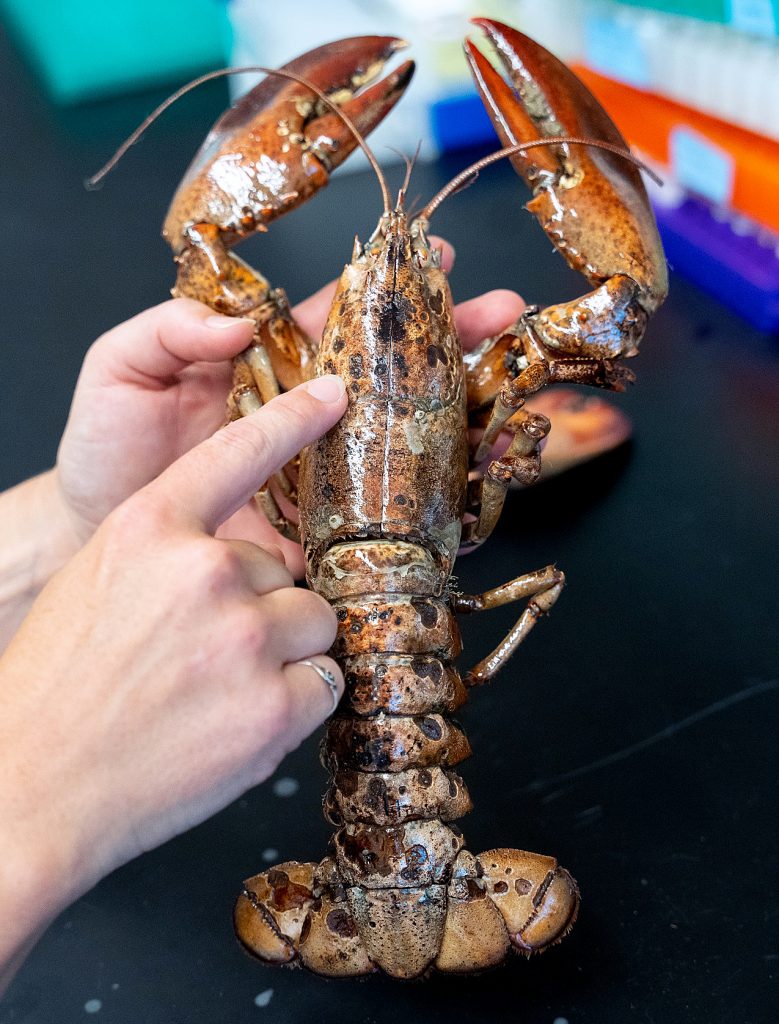
Led by Postdoctoral Scientist Melissa Rocker, Bigelow Laboratory researchers published a new study yesterday that looks at the spread of epizootic shell disease in American lobsters and won an editor’s choice in the ICES Journal of Marine Science.
Rocker ran a massive experiment for over a third of a year looking at the interactions between water temperature and molt timing to understand the impacts of epizootic shell disease on two different regional lobster populations. By highlighting population-level differences in disease progression, and how ESD is influenced by rising temperatures, the work is helping resource managers and industry better understand the threat of disease in a warming ocean.
This research wouldn’t have been possible without the help of the entire Quantitative Marine Disease Ecology Lab, led by Senior Research Scientist Maya Groner, as well as several undergraduate interns and scientists at the Maine Department of Maine Resources.
Rocker’s experiment is part of a larger project run by Groner on how warming temperatures may make Gulf of Maine lobsters vulnerable to disease like ESD.